Social Icons

Showing posts with label Vegetable: Grains. Show all posts

May 28, 2012

Grow Flax Seed in a Home Garden

My adventure with the small grains, namely Flax Seed and Barley finally came to fruition. I harvested both grains about two weeks ago. I did not have the time to properly process Barley, so it all went to the chickens (who loved it!), but did process the Flax Seeds. It turned out to be a rather easy process. To harvest I simply pulled the whole plants and put them into the garden cart. I imagine, commercially they harvest just the seed heads with the machinery, but I cut or pulled the seed heads by hand and literally separated seeds from the shaft. The shaft is very useful in itself, our ancestors used it to make linen. But I will use it in compost, or even possibly as straw mulch.


The seed heads need to dry crisp before threshing, so I let these sit outside in the shade for a couple of weeks.


After the seeds were very dry, I just rubbed the seed heads between my palms so that the seed itself was separated from the surrounding seed head. The process was quite easy. Then I sifted this mess several times through a regular colander until most of the debris was gone.

Last few sifts involved a fan (do this outside!) to sift the seeds at a height of approximately twelve inches from the lower bowl so that the light-weight debris can be blown away and the heavier seeds remain.
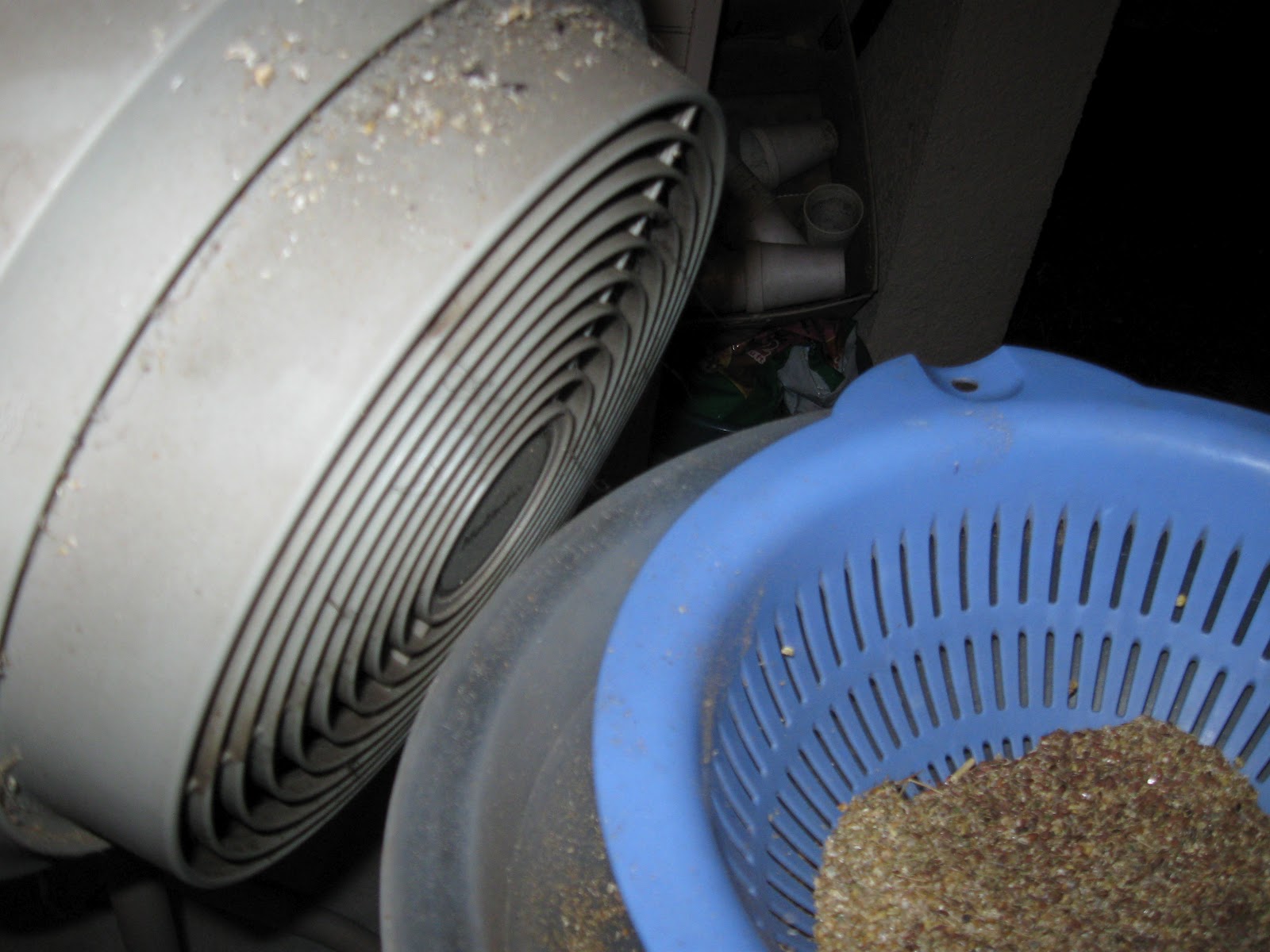


And here is the final product! These flax seeds certainly do not look as clean as when you buy them in the store, but they are certainly useful and very nice.


All in all, my yield was about 1:20. I seeded two tablespoons of the flax seeds and harvested almost a quarter a pound. This venture is certainly worth trying, and I plan to seed these (now free seeds) in October or when it gets cooler, to harvest in the following Spring.

April 7, 2012

Yet another update on flaxseed and barley - getting close to harvest!

I knew that flax flowers in a beautiful baby blue, but have never seen it in real life. Now it is my chance to enjoy that beauty:


These pictures were taken about two weeks ago, and every day there are more and more flowers in the bed of flax. After the flower is fallen, which is about one day, a tiny mother forms, probably filled with seeds. I cannot wait till harvest, to get my own flax seed, for the next year's planting, as well as adding it to the salads.

Barley is going into seed (food!) as well. Most of the stalks have seed heads now. I tried to thresh a couple, but they were not ready yet. I have to be patient. Judging from the pictures of wheat harvesting, the whole crop should be yellow by harvest, seed heads and the plants themselves. So, for now, I will keep them watered, and my impatience in check.

February 28, 2012

Growing Small Grains in Florida - Update

Late January I seeded some Flax and Barley as an experiment on growing small grains in Florida. This was my first time ever trying to grow these unusual vegetables. With little to lose I devoted about forty square feet of my garden to these grains. To my surprise and pleasure, both are doing extremely well so far. Here's flax:


Flax is an interesting plant. It is very upright and grows in a small footprint leaving a rosette of leaves behind. I think it is ready to set buds and flowers, at least that's how it looks to me from this close-up. Granted, it takes about three months to get to harvest, and we are only at the end of month one.


Here's the wall of barley. Another sturdy plant, it likes moisture and cool temperatures. The ones at the south edge of the bed are yellowing out a bit, but the rest are doing pretty well.


I also threw down a handful of bird-seed mix. I did not bother to remove the sunflower seeds from the mix and was punished for my laziness. Sunflowers overpowered every other plant in the mix, so now I basically have just a sunflower crop. But that is not a big issue, I will see how these sunflowers produce. I read somewhere that people who have bird feeders always have "free" sunflowers growing. That is not a bad problem to have.


In any event, even though it is not a tradition to grow grains in Florida, it might work on a small scale to produce organic low-gluten grain for food, as well as good compost material from their leaves and stems.

January 30, 2012

Growing Small Grains in Florida

A little while ago I performed a germination test of barley and flax seed. The test was successful, so I decided to seed some barley and flax in the garden. Right now it is a perfect time to try these grains in the garden: the weather is not hot yet, and we have about three to four months of relatively nice weather, and that's all these grains need, ninety to hundred and twenty days to harvest. That brings me to late May, at the latest, to harvest these small grains.

I seeded about sixteen square feet each, flax and barley straight onto the soil:


I just broadcast the seeds like you would throw fertilizer, and then sprinkled with soil. I read that you need to seed about forty seeds per square foot each, flax and barley. I kept the ground moist at all times, watering twice a day. I also stretched a bit of deer netting over the seeded area to keep the birds out. The seeds came up about two days later than they did in a germination test, all in all, very nicely.

Here's flax:


And barley:


It is difficult to find any information on growing small grains in Florida, possibly because it is not done commercially. But on a backyard gardener scale, I think it is a feasible project. I did it to try to grow my own low-gluten grains, as well as possible chicken feed, and of course, flax is a wondrous Omega-3 rich product. Even in the event if this project fails, it would still provide plenty of compost material for the garden, so it is a win-win situation no matter how you slice it.

October 8, 2011

Growing small grains

I germinated some bird seed for sprouts sometime in June. We happily juiced the sprouts but the plants still had the roots and stems living. I felt bad throwing them into compost, so I planted it in the corner of the bed. There were probably forty or so plants there, but some survived summer heat and neglect. Now I have a small grain harvest:


I'm not sure what kind of grain these are, as far as I remember the package listed wheat, millet and milo, possibly some others. But the experiment is worth the try. You might not produce enough grain to feed the family, but will have some to make artisan bread and have more free seeds for the next season. I am going to try to seed maybe forty square feet of grain next spring. I imagine they should be seeded in February, just like any other warm season vegetable.

August 19, 2011

Germinating Bird Seed for the chooks

"Chooks", that's what they call chickens in Britain. I have some too, very young ones, only two weeks old. Exactly four Plymouth Rock females, four Red Star females from MyPetChicken.com and ten Buff Orpingtons of unknown gender incubated by me, so eighteen chooks all together.

Usually when I have young chickens I carry them by hand into the outdoor play area in the morning and then back again, by hand, into their brooder at night. But recently my work schedule changed where I have to leave early in the morning and come back home late at night. I did not want to deprive the chooks of needed vitamins and entertainment, so I came up with a plan that I would grow greenery for them in a container. The plan worked very well. I got a six-pound bag of bird seed from Tractor Supply for about five dollars, so it's less than a dollar a pound, and seeded it liberally in a container. The germination of it was exceptional, very thick and lush greenery as a result. Chooks loved it!


The good thing about the bird seed is that it contains a few different types of grain: wheat, milo, millet and even sunflowers. There are other ingredients as well, but I threw away the package so cannot recall exactly. Some people like to juice germinated wheat, and that's a good healthy thing. The point is that you can get your grains for germination pretty cheap; bird seed is sold practically in every pet department at WalMart or your grocery store. And you can even grow this bird seed for the future seed if you let a few plants mature and go to seed. Way to go, I am pretty pleased with that project. 
 

Florida Gardening

Florida Gardening Blog

Visitors from all over the world

Grow Your Own Food

Grow your own food, be independent, healthy and happy.