Social Icons

Showing posts with label Pest Control. Show all posts

July 7, 2013

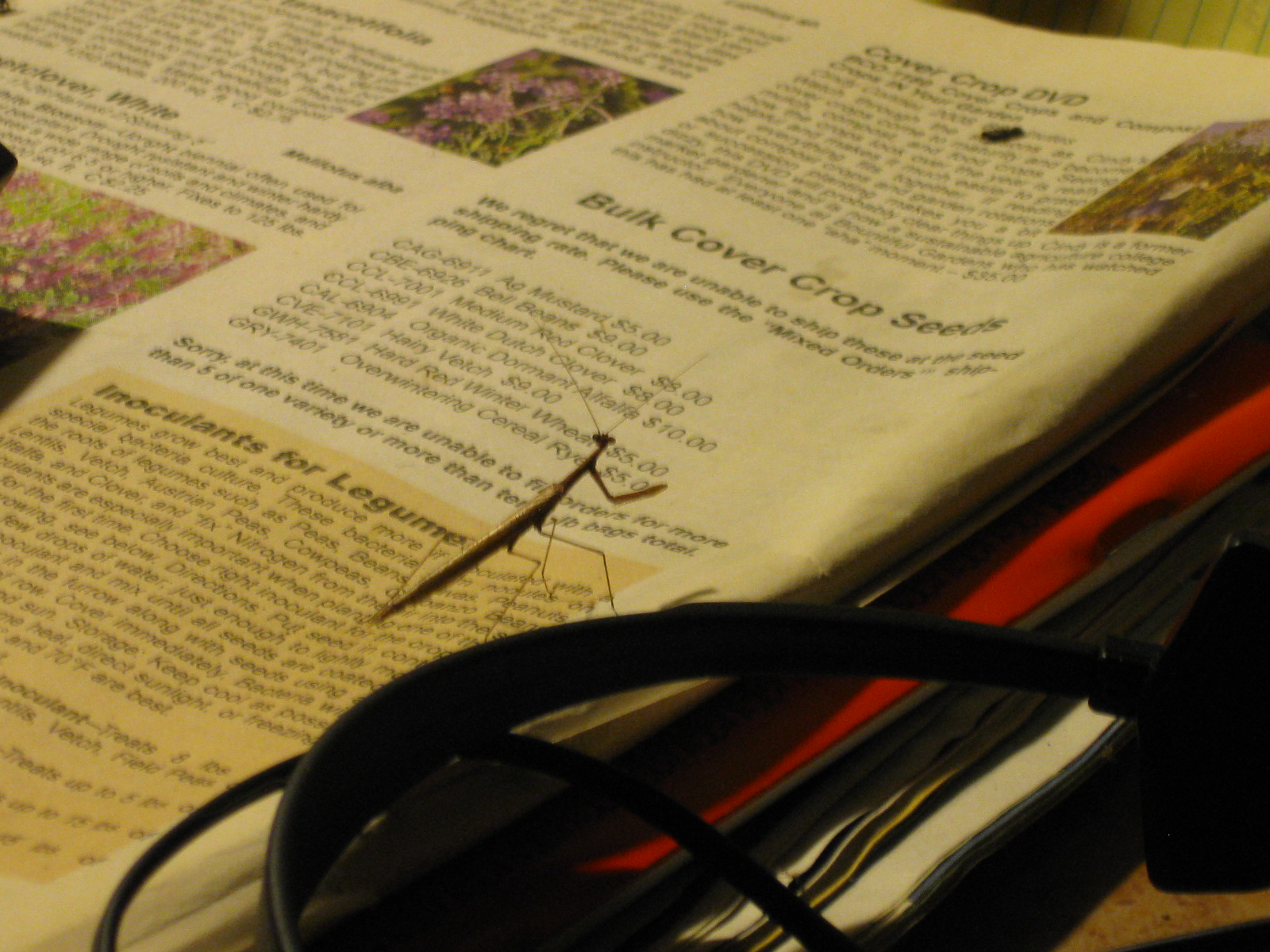
Praying Mantis

That's one bug you want to attract and keep. They are a predator insect, and feed on moths, mosquitoes, flies, and crickets, among other things.

This particular individual decided to land on my seed catalog. Maybe it was hinting at something, or was learning to read... In any event, this was a pretty fun picture to take.


So, when you see a little fella like this in your garden, do not shoo it away or kill it. It might do your garden a favor by eating a few bugs here and there.

October 6, 2011

Pickleworm control

Pickleworms are common on cucumbers and squash. I don't use pesticides, so my pest control is manual. Luckily, these worms are easy to identify. They like to wrap themselves around in the leaves of the squash or the cucumber and lay the eggs there so that their youngsters have immediate access to food.

You need to pay attention to the leaves. When you see damage to the leaves, examine the under part of the leaves, and especially when you see leaves curled up and sealed like this:


When you open the curled part you would find a small green worm sitting there:


Destroy this thing immediately and keep checking the leaves for other pickleworms. The plant will survive with some leaf damage, but it will be a problem, if unchecked, when you start harvesting because pickleworms will destroy fruit. You might try BT to control the worms, but it has to be applied regularly as it washes off with rain and watering.

July 12, 2011

Crop rotation in your home garden

Let me start with an example of bad crop rotation (I do not always do as I preach ... :))


As you can see on the picture, the roots have bumps on them and are swollen. You can click on the picture to enlarge and see the details. These roots are tomato roots damaged by nematodes. Nematodes are a problem in Florida and they usually attack nightshade family of plants, such as tomatoes, peppers and eggplant.


One school of thought to remedy nematode problem is to "solarize" your soil, which involves covering the soil with plastic and let it sit in the heat of the summer, thus raising soil temperature to some 130 degrees and killing nematodes. I do not like this method because in addition to killing nematodes it will also kill beneficial insects and organisms that are much welcome in the garden, especially earth worms. If I were a fisherman, or fisherwoman, I could dig at least a shovel full of worms from my garden every day. And I like that! Earth worms make best manure because they eat and excrete plant matter, as well as dig furrows in the garden and aerate the soil.

So my answer to nematodes or other damaging pests is crop rotation. In a small garden crop rotation might be a challenging task. I have devised an "easy" plan to accomplish this.

First, divide vegetables that you plan to grow in three groups: Nightshade (tomatoes, peppers, eggplant and regular potatoes), Cover Crop (cowpeas, snap peas, beans) and Other (carrots, lettuce, broccoli, cabbage, okra, amaranth, radish, etc).

Second, draw your garden on a piece of paper and divide it in three parts, that's your master plan. I actually divide each bed into three parts, which takes care of dividing the whole garden. Then rotate your crop:

FallNightshadeCover CropOther

WinterOtherOtherCover Crop

SpringCover CropNightshadeOther

SummerOtherCover CropCover Crop

FallCover CropOtherNightshade

WinterOtherCover CropOther

SpringNightshadeOtherCover Crop

SummerCover CropCover CropOther

Pictured above is a 2 year rotation plan. As you can see, Nightshade family is not planted in the same space for a year and a half, which I think is a pretty reasonable time.

Since Nightshade family is most successible to pest damage, it is important to move it around; the rest of the vegetables, Other and Cover Crop are interchangeable: you can create your own rotation schedule with them freely depending on your vegetable needs.

In addition to crop rotation I always tuck flowers, especially Marigolds, and herbs in "Nightshade" and "Other" parts of the garden to provide bio-diversity and beauty to the garden, as well as attract beneficial insects.
June 23, 2011

Plant for pest damage

I am a huge fan of Eco-system gardening: I like my vegetables organic and I do not want to do any additional work, such as spraying insecticides if I can help it. An Eco-system will not happen by itself and it will not happen overnight. But it is not an unattainable goal either. I have been gardening on our property for almost two years now, since we moved, and I can attest that not only I do not use any pesticides, even organic ones such as BT or soap spray, but I also have minimal pest damage.

I am a follower of John Jeavons system, detailed in his book "How to grow more vegetables". He states, and I have proven it in practice, that pest control starts in the soil. I am double-digging my new beds and adding a lot of organic material to the new beds when I am building them. After I plant, I mulch heavily, and then dig that mulch in after the harvest. I usually plant more than we can eat, so some insect damage to the fruit is not a big deal. It also helps, as Jeavons suggests, to plant in season and give plants proper care, e.g. watering.

Here's a swiss chard leave eaten by some insects. It is not the plant's fault, this plant should have been cut to the ground and watered every day to allow only new leaves, because swiss chard is a cool season vegetable and can only stay in "maintenance" mode during the summer:


Something chewed a hole through this tomato:

and this one:

Why? Because these roma tomatoes are done fruiting and should have been harvested, as well as kept being watered and shaded during our hot and dry season in May and June. 

There are some chewed holes in okra leaves:

But it is not really a big deal. Okra grows in it's proper season now and is cared for, so it will be fine. John Jeavons rightly suggests that pests should be dealt with control, not death and poison. If I sprayed these tomatoes or okra plants with some pesticide, chances are the leaf-chewing insects would be dead, but beneficial insects that eat them would be dead too. Then, the next higher up insect or animal on the food chain will not have enough of food and go elsewhere, which can lead to some other insect over-populating the garden.

John writes in his book that they did an experiment, where they planted a bed of green beans and let insects have at it. Some thirty percent of the leaves were eaten by pests, but bean yield itself increased, compared to the controlled bed. Interesting...

Garden Eco-system is delicate, but also very robust; my garden is a testimony to this practice. If you are interested in John's work, here's the book that is prominent on my bookshelf:


Florida Gardening

Florida Gardening Blog

Visitors from all over the world

Grow Your Own Food

Grow your own food, be independent, healthy and happy.